Caribbean · · 9 min read
7 Caribbean Islands I'd Actually Book During Hurricane Season
Hurricane season doesn't close the Caribbean. It just means knowing which islands sit out of the storm's way, which ones I'd skip right now, and how to protect the trip before you put money down.
Most people think hurricane season means crossing the Caribbean off the calendar from June to November. It doesn't. It means knowing which islands sit out of the storm's way, and which ones you're quietly rolling the dice on.
The Caribbean doesn't shut down for six months. The risk just isn't spread evenly across it. Some islands sit so far south that storms curve away long before they get close. Others sit right in the lane. The whole game is knowing the difference before you put money down.
Quick answer: The Atlantic hurricane season runs June 1 through November 30 and peaks from mid-August through October. The lowest-risk islands all sit in the southern Caribbean, below or east of the main storm track. Aruba, Bonaire, and Curaçao lead the list, followed by Barbados, Grenada, and the southern sailing islands. Two names that show up on every list, Trinidad and Margarita Island, sit outside the storm path but carry current U.S. State Department advisories you should know about before you book.
Can you actually travel to the Caribbean during hurricane season?
Yes. And most people who do go come home with a perfectly good trip and zero drama.
The Atlantic season runs June 1 to November 30, with the real activity clustered from mid-August through late September into October. That stretch is when the northern islands get the most attention. The southern Caribbean stays comparatively calm right through it.
Here's the part the panic headlines skip. The risk isn't "a hurricane will hit your vacation." A direct hit on any single island in any single week is rare. The real risk is disruption. A storm three islands away that delays your flights, closes a beach, or turns your arrival day into a travel day. That's the thing worth planning around.
So the move isn't avoiding the Caribbean. It's picking the part of it storms tend to skip, then protecting the money you put down. More on that second part below, because it's the piece people get wrong.
The 7 islands I'd book
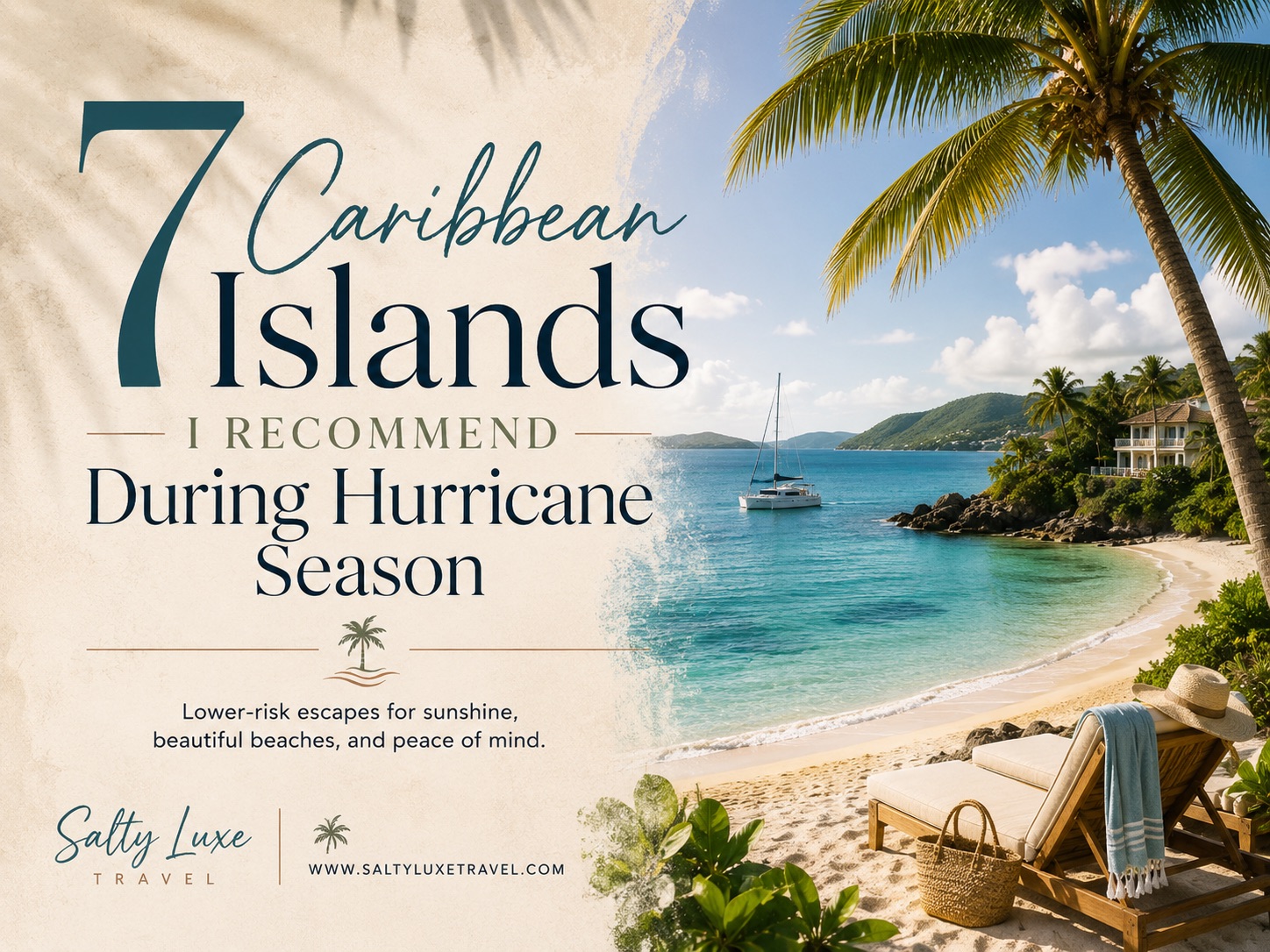
These run in the order on the graphic. I've added the part most lists leave out: the tradeoff, and where each one actually fits.
1. Aruba
The first island I reach for. It sits well south of the storm belt, runs dry, and gets steady trade winds, so peak season weather tends to look like a quick passing shower, not a multi-day washout. Strong resort infrastructure and easy nonstop flights from the U.S.
The tradeoff: Aruba is flat and arid. Cactus and divi-divi trees, not rainforest. If you want lush green, this isn't the one. If you want a sure thing with sun, it's hard to beat.
Best for: first timers, families, anyone who wants minimal forecast anxiety.
2. Bonaire
Same southern position, same low risk, built almost entirely around the water. The reef sits right off the shore, and it's one of the best diving and snorkeling islands in the region.
The tradeoff: this is not a big resort, float by the-pool island. It's quieter, smaller, fewer large properties. You come for what's under the surface, not the nightlife.
Best for: divers, snorkelers, couples who want calm over crowds.
3. Curaçao
The middle ground of the ABCs. You get the same dry, low risk weather plus the pastel waterfront of Willemstad, a UNESCO site, with more food, culture, and history than its neighbors.
The tradeoff: the beaches are pretty coves tucked into the coastline, not one long uninterrupted stretch of sand. If your idea of a beach is a single endless shoreline, adjust expectations.
Best for: travelers who want beach plus something to actually do and see.
4. Barbados
The eastern edge of the Caribbean, sitting out past the main track. Currently a Level 1 advisory, strong infrastructure, and some of the best food in the region.
The tradeoff: it's east of the belt, not below it, so the risk is low but not the near zero of the ABCs. The Atlantic side has rougher surf, so you want the calmer west and south coasts for swimming. Beryl was a reminder in 2024 that Barbados isn't untouchable.
Best for: a fuller island experience, great dining, travelers who book with coverage in place.
5. Grenada
The Spice Island. Lush, green, genuinely slow paced, and sitting on the southern fringe of the belt where most storms pass north.
Two tradeoffs. Fringe is not immune. Hurricane Ivan hit Grenada hard in 2004, and Beryl battered the region in 2024. And as of January 2026, Grenada moved to a Level 2: Exercise Increased Caution advisory after a crime indicator was added. Still a reasonable pick, with normal travel smart precautions.
Best for: couples who want green and character over big brand resorts.
6. The Grenadines
A string of small sailing islands sitting below the main path. Barefoot fancy, catamaran territory, some of the prettiest water in the Caribbean.
The tradeoff: Beryl did real damage here in 2024, and several islands, including Union Island, are still working through recovery. This is a sailing and boutique experience, not a big resort one, so you confirm property status before you commit.
Best for: sailing trips, multi-island itineraries, travelers who want quiet and water.
7. St. Vincent
The hub of the Grenadines and the gateway to that whole sailing world. Far south, currently a Level 1 advisory, friendlier to a slower pace.
The tradeoff: it's more rugged and local than polished resort, with an active volcano, La Soufrière, as part of the landscape. Same Beryl region recovery note applies to parts of the chain.
Best for: sailors and travelers who want off-the-beaten-path over manicured.
Travel insurance and CFAR: the part I don't make optional
Here's where I stop being flexible. If you're traveling during hurricane season, you protect the trip. Not because something will go wrong, but because the one time it does, the difference between a stressful week and a five figure loss is a policy you bought months earlier. Insurance isn't the upsell. It's the seatbelt.
And there's a specific trap people fall into. Standard trip cancellation coverage only pays out for named reasons listed in the policy. A storm that's merely in the forecast, or a resort that technically stays open while the weather looks ugly, often won't trigger it. You're left watching the radar with no way out that gets your money back. That's where CFAR comes in.
CFAR stands for Cancel For Any Reason. It's an optional add on to a standard policy, and it does exactly what the name says. You can cancel for any reason at all, including "the forecast looks bad and I'm not risking it," and recover a portion of what you prepaid. Typical reimbursement runs 50 to 75 percent of your nonrefundable costs, depending on the plan.
The rules matter, because this is where people lose the option:
You usually have to buy CFAR within roughly 14 to 21 days of your first trip deposit. Miss that window and you can't add it.
You typically have to insure 100 percent of your prepaid, nonrefundable costs. You generally have to cancel at least 48 hours before departure, sometimes 72. It costs more, often adding 40 to 50 percent or more on top of the base policy.
It isn't sold in every state.
The big one for hurricane season: you can't add CFAR once a storm has a name and the weather is already a known event. By then it's too late. You buy it early, when you book, or you don't get it. That's the entire reason I bring up insurance on day one, not as an afterthought once the deposits are in.
One note. Terms and reimbursement vary by plan and by your state of residence, and I'm not the insurer, so we confirm the specifics with the provider before you buy. But the principle doesn't change. If you're spending real money on a trip in storm season, CFAR is the off ramp that lets you make the smart call without eating the whole cost. I'll walk you through whether it makes sense for your trip and connect you with the right coverage.
How I help you pick, and why you're not doing this alone
You don't need ten browser tabs and a group chat to figure this out. You need someone who's already sorted the good bets from the bad ones.
That's the job. I narrow the list to the islands and resorts that actually fit how you travel, not just what photographs well. I flag the advisories, the recovery zones, and the beaches that aren't swimmable before you fall in love with a photo. And I don't stop once you've booked. I re check pricing, room categories, and conditions right up to your trip, because storm season is exactly when details shift. You don't plan trips anymore. You have someone who handles them.
If you're done comparing resorts and second guessing every detail, start with my inquiry form at saltyluxetravel.com or reach me at kristin@saltyluxetravel.com. Tell me when you want to go and who's coming, and I'll tell you where actually makes sense, and where I'd steer you away from.
FAQ: Caribbean travel during hurricane season
What's the safest Caribbean island during hurricane season? Aruba is the strongest single bet. It sits well south of the storm belt, runs dry, and sees very few direct hurricane strikes in modern records. Bonaire and Curaçao are right beside it on the list.
When is hurricane season in the Caribbean? June 1 through November 30, with the highest activity from mid-August through October. The southern islands stay relatively calm even through the peak.
Which Caribbean islands are outside the hurricane belt? The ABC islands, Aruba, Bonaire, and Curaçao, are the classic answer. Barbados, Grenada, the Grenadines, St. Vincent, and Trinidad and Tobago also sit below or east of the main track, so they see far fewer direct hits than the central and northern Caribbean. Lower risk, though, not zero.
Is it cheaper to travel to the Caribbean during hurricane season? Often yes. Rates tend to drop from late summer into fall. The savings are real, but only worth it if you book a lower-risk island and protect the trip with the right insurance.
Does travel insurance cover hurricanes? Standard trip cancellation covers specific named reasons, and a forecasted storm or an open-but-stormy resort often doesn't qualify. CFAR (Cancel For Any Reason) coverage is what lets you cancel on your own judgment and recover 50 to 75 percent of prepaid costs, as long as you bought it early, before the storm became a known event.
What happens if a hurricane is heading toward my trip? If you planned ahead, you have options. With CFAR in place, you can make the call to cancel and recover most of your money. Without it, you're often stuck choosing between traveling into bad weather or losing your deposits. This is the whole reason coverage goes on at booking.
Should I avoid Trinidad and Margarita Island? Both sit outside the main storm path, so weather isn't the concern. The concern is that both currently carry Level 3 advisories, Trinidad and Tobago for crime and a state of emergency, and Margarita Island as part of Venezuela. I'm not booking client trips to either right now. Confirm current advisories at travel.state.gov before making any decision.
The Caribbean is wide open in storm season. You just have to know which part of it the storms tend to skip, and protect the trip before you ever pack a bag.